
Times change. As a kid, the Chocolate Chip Cookie Dough at Baskin Robbins was the pinnacle of all things dessert. That freezer-burnt, rock-hard scoop of goodness on top of a cheap, crumbly cake cone…
Those were innocent times. Then came college, and ventures into Wallingford, and a little magic something called Fainting Goat Gelato. Embarrassingly, I’ll admit that it first caught my attention through a sweet Groupon deal. But this small, family-owned store had a draw of its own.
Fainting Goat is the dream shop of couple Yalcin and Sevim Ataman, hailing all the way from the faraway city of İzmir, Turkey. In 2009, they brought their talents to Wallingford, with all three of their daughters lending a helping hand. Almost as remarkable as the Atamans’ journey is their signature flavor: Goat Milk Mastic. I know, I know—Goat Milk what? It’s a flavor I would wager can’t be found anywhere else in the state, or even the country.
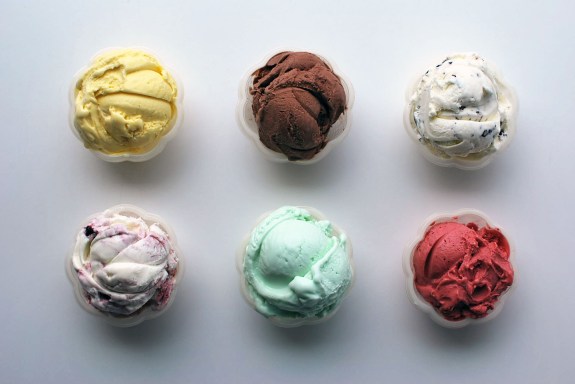
So what is it, exactly? It’s a whole lot of work for one flavor: First, they replace the standard cow’s milk with goat’s milk. Second, they enhance the flavor and texture with Mastic, which is a plant resin from the Mastic tree, traditionally used in everything from Turkish delight to liquor to cakes and pastries throughout the Mediterranean. In much earlier times, it was even used as a sort of chewing gum.
As you might imagine, this resin gives the gelato a hint of a chewier, bouncier texture. Both the goat’s milk and Mastic are actually quite subtle to taste. Still, the small differences culminate in you or I taking a creamy bite and saying, “Wow, that is GOOD.”

The Goat Milk Mastic in front of some familiar sights.
So here’s a mystery that Fainting Goat brought fluttering to the top of my brain: what really is the difference between gelato and ice cream? According to multiple sources, ice cream is made with a higher ratio of cream to milk, by rule resulting in at least 10% fat. It follows that gelato uses more whole milk and less cream, thus resulting in a (surprisingly) lower fat content, around 5 to 7%.
Hold up, you say. What gives? Why does gelato seem to taste smoother and denser if it’s just the low-fat cousin of ice cream? Shouldn’t it taste like…well…low-fat ice cream? Turns out there are other major differences between the two desserts: their churning speeds, and the temperatures they’re served at.
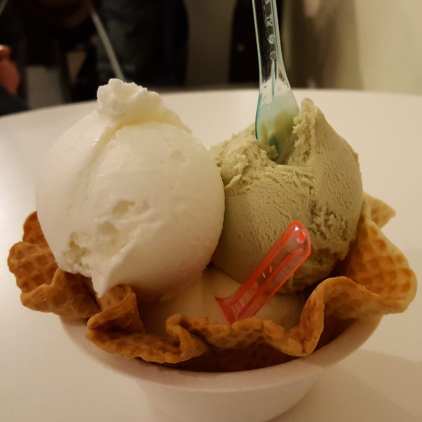
A crunchy waffle bowl if you’re feeling ambitious.
Gelato is churned at a much slower speed. This whips less air into the mixture, packing in more gelato goodness into each bite. In fact, some commercial ice creams even reach the point where an entire half of each bite is simply composed of air!
Gelato is also stored at a higher temperature than ice cream. Because of how dense it is, if gelato was stored at the same temperature as ice cream, it’d resemble a hockey puck more than a dessert. Instead, the extra warmth sends more of its ice crystals into liquid form. This is also how soft-serve ice cream works: it’s plain old regular ice cream, just stored warmer!
Package together all of the above with some carefully sourced ingredients, owners that care immensely about their product, and some truly intriguing flavor combinations, and you have some excellent, excellent gelato. Some folks will take a scoop of Molly Moon’s over Fainting Goat any summer day. That’s fine. We’re not here to draw battle lines; eat what you like to eat! As for myself, I know exactly where I’m headed if I’m on the hunt for a smooth treat—and I’m not talking Baskin Robbins.
 S E A
S E A 